
The (metaphorical) jury’s still out
Times are dark in the US. There’s a laundry list of ways that’s true, but climate is certainly on the list. What can be done when day after day this federal government bludgeons climate progress, seemingly setting back the entire movement? Of course, the fight continues every day as local and state-level organizers and community members refuse to let up trying to make the world a bit more climate-resilient. But one of the last avenues for forcing federal action slowly in the direction of climate justice, is the courts. Can we rely on the judicial system to uphold climate justice when the executive and legislative branches have failed us? Lately some have dared to request something the courts have never been asked before. Can they deliver climate justice for children specifically?
Imagine yourself at age eight. What were you doing?
Probably running around with your friends in the great outdoors, or playing sports and video games after school. Hopefully generally enjoying the freedom of childhood. And probably not suing the federal government.
The memories of childhood most adults hold dear are starting to diverge greatly from the lived reality of many children today. That’s because the climate itself looks and feels starkly different. And in this different world in which kids can face up to 7 times more climate disasters than people born in 1960, childhood doesn’t get to be as innocent. Too many kids now grow up facing terrible disasters that force them to miss school and activities, wrestle with chronic illnesses, and even get displaced from their homes. They have fewer safe outdoor spaces to recreate in and fewer safe weather days to do so; they have dirtier air that chokes and poisons them, and hotter days that fog their brains. Children heavily impacted by and distressed about the climate crisis have poured their hearts into volunteering, advocacy work, and lobbying their politicians, and they watch as emissions have still continued to increase, stealing not just the bright futures they’ve been promised, but their present – in real time. All these hours of childhood innocence lost to standing up for their rights can’t be returned. The asthma and illnesses many of these children have acquired from wildfire smoke and air pollution can’t be reversed. The days of critical learning with friends in school lost to climate-induced school closures can’t be recouped. The mental health conditions that inevitably arise from traumatic losses of homes and stability and constant climate anxiety can’t be easily wiped away. And harms impact children uniquely because they are still developing – their physical and nervous systems aren’t as robust as adults, so devastating events hit them harder, permanently alter their development and have more enduring effects. They can’t vote or stand for election, and they have little if any of their own dollars to vote with, either. So now, kids are standing up and taking their grievances to court.
Kids are suing their governments, not because they wouldn’t rather be frolicking carefree, but because they’re mad about their present, petrified of their future, and have nowhere else to turn for justice.
Genesis B. v. EPA is a lawsuit brought in December 2023 by 18 Californian youth plaintiffs, ages 8 to 17, against the US EPA. Our Children’s Trust is the public-interest legal non-profit that represents the children in this climate lawsuit, free of charge. (Since 2010, Our Children’s Trust has existed exclusively to represent and support young people in active climate litigation.) The youth plaintiffs allege the federal government agency, whose founding purpose is to protect human health and safeguard the natural environment, has failed to protect children from the harms of climate change with their policies that allow carbon emissions in such high amounts. They also argue the EPA has discriminated against and disproportionately harmed children and future generations by discounting the economic value of future lives compared to lives today in their regulatory cost-benefit analyses. The EPA has never employed a 0% discount rate to weigh current adults equal to current children, and plaintiffs say that constitutes discrimination. Their ask? A simple declaratory judgment and clarification. They want the court to say the EPA has violated these children’s constitutional rights to life and equal protection under the law. They also want the court to clarify the standard of judicial review (meaning the legal lens through which an appeals court examines the lower court’s decision) when it comes to the rights of children as a special protected class, different from adults. The case has been dismissed by the federal district court for lacking standing, saying the plaintiffs’ harms were not traceable to the EPA’s policies. The court also said the plaintiffs were unable to demonstrate redressability, and that their harms were not specific, but “generalized grievances.” Our Children’s Trust decided to appeal.
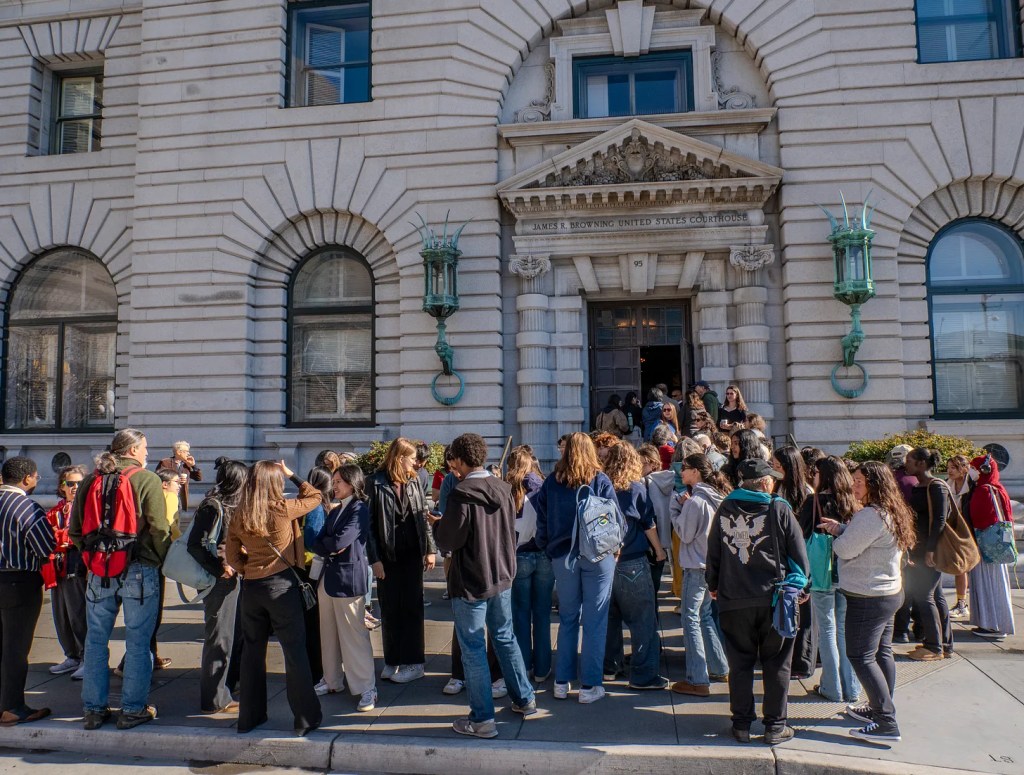
On Thursday, March 5, myself and a packed overflow room, of mostly youth, listened to oral arguments presented to the Ninth Circuit Court of Appeals at the James R. Browning U.S. Courthouse in San Francisco. The purpose of this hearing was to ask the Ninth Circuit to reinstate the case.
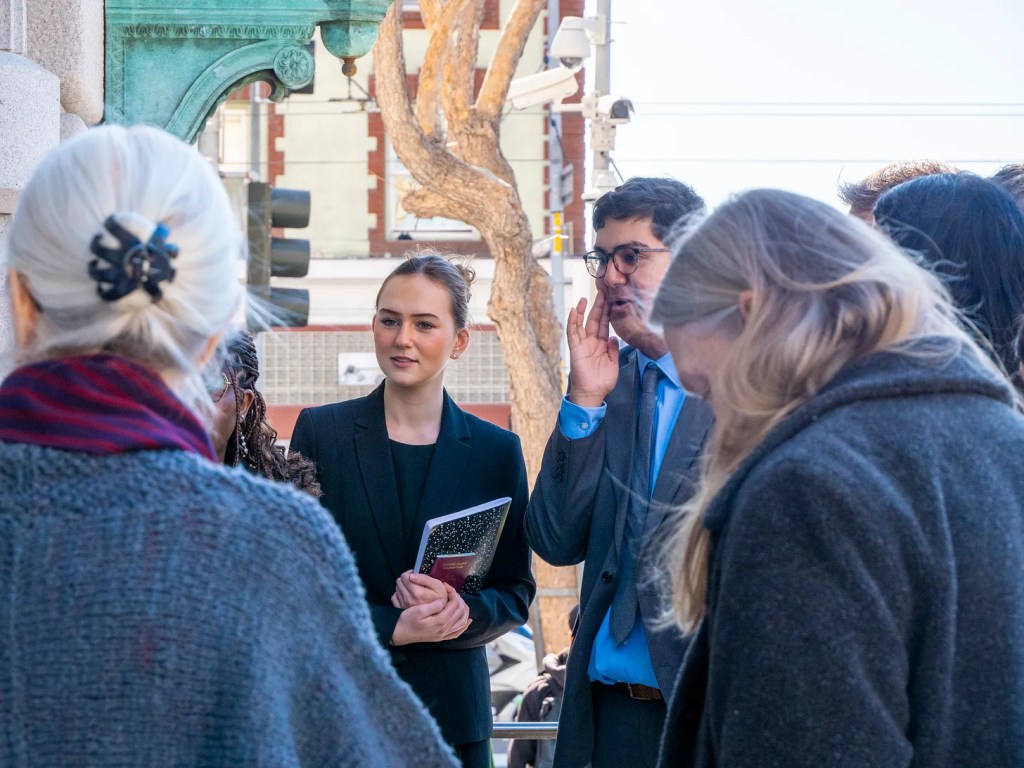
I arrived 30 minutes before the hearing began, surprised to find a large crowd of eager people standing around outside, waiting to be let into the courthouse like it was the hot new restaurant on the block. I was there for research but also in a personal capacity as a community member, responding to a call to action from 350 Bay Area to ‘pack the courtroom’ to show the judges how many people are standing with the youth plaintiffs on this case. It was exciting to see that call would be answered. From a bit of chatting, I learned that most of the crowd consisted of high school students, representing at least Redwood high school and Lincoln high school. One of the large groups of students had actually come on a field trip, not specifically because of this case, but simply because they come to this courthouse on this day every year – getting to catch this youth climate hearing was pure serendipity. In addition to the youth plaintiffs and their legal team, there were several other representatives from Our Children’s Trust, and a couple of reporters and photographers.
Because I don’t like standing in one spot for too long, at one point I walked around to the side of the courthouse. Immediately I noticed a large mural of a young girl with flowers on the building wall adjacent to the courthouse. It felt very on theme for the day, and got me thinking about the case – about children and what we owe them.

That is also the question at the core of Genesis v EPA. But while hearing the plaintiffs’ lawyer present oral arguments, the three judge panel is not concerned about the philosophical ethics of what we owe children, but, of course, the legal intricacies of the case. In the hearing, they ask pointed questions to decide if an entire class such as children can be discriminated against, if intention to discriminate exists, whether the allegations of harm are “in fact” or “speculative” and whether they can be causally attributed to the EPA’s policies. They even have to consider whether a favorable ruling would actually help the plaintiffs’ situation. The judges seemed pretty skeptical, but we won’t know their decision until later.
“What’s so unique about Genesis is it’s a legal action that the government is legally required to respond to. They don’t have a choice to just look the other way and pretend that we’re not there,” Maya Williams, one of the youth plaintiffs, told Bay Nature. “I think the reason that the EPA has dedicated so much time and resources to blocking this case is that they know that at the end of the day, if Genesis v. EPA or Venner v. EPA were to go to trial, and we had a judge rule in our favor, that would fundamentally change the way that they have to go about regulating fossil fuel emissions.”
While it would be huge to win this federal case, rejections in the courtroom don’t seem to be the least bit deterring for Our Children’s Trust. They are firing from all cylinders to achieve court-backed protection of children from the climate crisis wherever the chance exists. It’s proving to be somewhat of a numbers game. They have filed cases in all 50 states and at the federal level, and persistence eventually pays off. Amidst many losses, Our Children’s Trust has gained a few momentous wins. In 2023, youth plaintiffs won their case in Montana (Held v. Montana), affirming their right in the state’s constitution to a healthful environment; the 16 plaintiffs had taken aim at Montana’s government for zealously embracing fossil fuels despite this constitutional assurance. It was the first constitutional climate case in the US to reach a trial, and they won. Plaintiffs asked for a ruling that declares burning fossil fuels drives climate change, making the state’s support of the industry unconstitutional, and to strike down a provision barring the state from considering the climate implications of energy permitting decisions. The District Court Judge did just that. Our Children’s Trust-backed youth plaintiffs successfully made it to trial again in 2024, with Nawahine v. the Hawaiʻi Department of Transportation, suing Hawai‘i’s Department of Transportation over its role in promoting greenhouse gas emissions, also citing the right to a clean and healthful environment enshrined in the state’s constitution. The 14 youth plaintiffs won a settlement agreement to work alongside their government to achieve zero emissions in the transportation sector by 2045.
Many judges seek to punt anything related to climate change out of the judicial realm, seeing it as an issue only to be addressed by the legislative and executive branches. Legal norms aside, these judges may not understand that taking climate to the courts is often a last resort. Activists have been trying for decades to achieve climate progress through their governments’ channels, and the crisis is still not being properly addressed on anywhere near the scale needed. On many fronts, it’s actively being made worse. These climate lawsuits aren’t even asking for broad policy changes. They are simply asking the courts to be a voice of reason, to remind and point the other branches back towards the core constitutional values their actions are meant to uphold.
But there’s more going on behind the scenes. Climate strategies are constantly evolving, and things change fast especially under this administration. For example, what does it mean for the climate lawsuit landscape now that Trump has removed the EPA’s ability to regulate greenhouse gases at all? Known as the endangerment finding, this authority was recently ripped by this administration’s EPA (but already, people are suing over this – including many youth plaintiffs, in Venner v. EPA). To date, the American Petroleum Institute (API) has relied on the EPA having the authority to regulate point sources of greenhouse gas pollution (like power plants, oil refineries and pipelines), because it helps cushion fossil fuel companies’ from accountability for all the pollution they cause. The fossil fuel industry now fears that if they can’t defend themselves by saying there’s a federal agency tasked specifically to regulate this stuff, they’ll start losing in climate lawsuits. It gives states and local governments more say in that regulation, more authority to successfully sue. Fossil fuel companies have been facing an increasing amount of climate lawsuits and “polluter pays” or climate superfund laws that seek to hold them financially accountable for climate damage. (None of the three dozen local and state-level lawsuits against fossil fuel companies from the last decade have made it to trial yet.)
The impacts of the gutted endangerment finding remain to be seen, but vastly more concerning is the fact that the API isn’t caught unprepared. The oil industry has been hard at work lobbying for at least the past year. What’s their strategy now? They are trying to achieve total immunity. Fossil fuel companies are currently lobbying aggressively to obtain immunity from climate accountability akin to that of gun manufacturers’ immunity from lawsuits (see 2005’s Protection of Lawful Commerce in Arms Act). And now our current Supreme Court is also about to decide whether state and local jurisdictions will be allowed to continue suing the oil industry. The justices will weigh in on a case from Boulder, CO, and the oil industry hopes they rule that any climate lawsuits can only be appropriately brought at the federal level.
So, can courts deliver climate justice for children? So far, we’ve seen many losses, but a few notable wins. The goal of groups like Our Children’s Trust is to set precedents so more and more cases for climate justice can win. Each push, each individual case, each youth testimony, is a step in the direction of making the courts work for that purpose. Every case won’t be won, but the biggest offenders of all, fossil fuel companies, will get off scot-free in courts if Congress bars any legal accountability for their climate emissions.
What to do:
- Push your representatives to support and advocate for polluter pays / climate superfund laws. Sign this petition
- Email and call your representatives to tell them not to support corporate immunity laws for the fossil fuel industry
- Sign this petition to oppose immunity for Big Oil

 Clarity in Catastrophe
Leave a comment