
What movements have been missing
Minneapolis is the birthplace of many amazing things. The Milky Way candy bar. Masking tape. Water skis. The Great Northern Railroad.
It’s also been the site of many horrendous things, especially in very recent memory. George Floyd’s brutal murder at the hands of police on May 25, 2020, which ignited months of nationwide protests and widespread racial reckoning. Renee Good’s murder by ICE agents on January 7, 2026. Then Alex Pretti’s murder by ICE agents on January 24, less than 3 weeks later. The sites of all three infamous murders by the state are within just 2 miles of one another.
From immense tragedies and grief, the streets of Minneapolis have become fertile ground for powerful movements that spread like wildfire across the rest of the nation. The people of Minneapolis have quickly learned how to compost their collective trauma into contagious collective action. One of the most compelling ways we’ve watched Minnesotans do that is through their use of song. Immediately in the aftermath of Renee Good’s murder – just 4 days later – a group called The Bridge Singers stepped up, and a larger movement called the Singing Resistance was born. Within just a few days, 600 people joined together to sing their grief and love in the fight against ICE occupiers in their home. The movement galvanized even further after Alex Pretti’s murder, more than doubling the number of singers, with 1400 gathering at Hennepin Avenue United Methodist Church mere hours after his death. “We are here / With our city / Our love for each other will carry us through / Yes, our love for each other will carry us through.”
Minneapolis song leader Sarina Partridge spoke to CNN, describing the incredibly important role singing plays for those working to defend their neighbors in the eye of the ICE storm there. The stress and grief there these past couple of months seem pretty unimaginable, looking in from afar. It makes sense when Partridge says singing has helped people come together in these moments when there are no words. She describes the value of collective song as effectively helping them process and move through their grief, while at the same time summoning courage. Partridge says it is absolutely essential to tend to your grief in order to be able to continue showing up for your neighbors and not be paralyzed by it. My favorite quote from her interview: “I am afraid. And that’s the thing. I think that songs can be like spells that we cast on each other, where it’s a way to step into something that we can imagine feeling, and then while we’re singing it, it’s real. It’s a taste of what’s possible. And it becomes a little bit more real.”
A few of these singing resistance moments from Minnesota went viral, garnering nothing short of sheer admiration from onlookers the world over. In one, they soulfully sang outside of a Residence Inn hotel where ICE agents were staying: “It’s okay to change your mind / And you can join us, join us here any time / It’s okay to change your mind / Show us your courage, leave this behind.” (I cry every time). Fast forward a month later…
On Sunday afternoon, March 1, a group of 150-200 sang resistance songs – not in Minneapolis, but at a busy intersection in an international area of St. Louis, Missouri. One of those singers was my mom, who spoke with me about her experience. I was struck by her excitement to take part in this action. Even as a very justice-oriented woman, she admittedly tends to feel a lot of hesitation and uncertainty around what actions to take part in. She reflected: “I do have a bit of social anxiety. Protesting makes me nervous because I don’t like to stand out. But this feels safe because I know how to sing, I like to sing, and I agree with what they’re saying when they sing. I have a harder time standing on a corner to protest with people I don’t know and not knowing what to say. But I don’t feel that way with this at all.” It helped that she knew some of the organizers from her faith community. But another part of the relative ease she described in this form of protest is because there’s an actual guidebook for what to do while there – a songbook! The Singing Resistance has created and circulated a highly useful toolkit and songbook, making it utterly frictionless to choose songs and sing along.
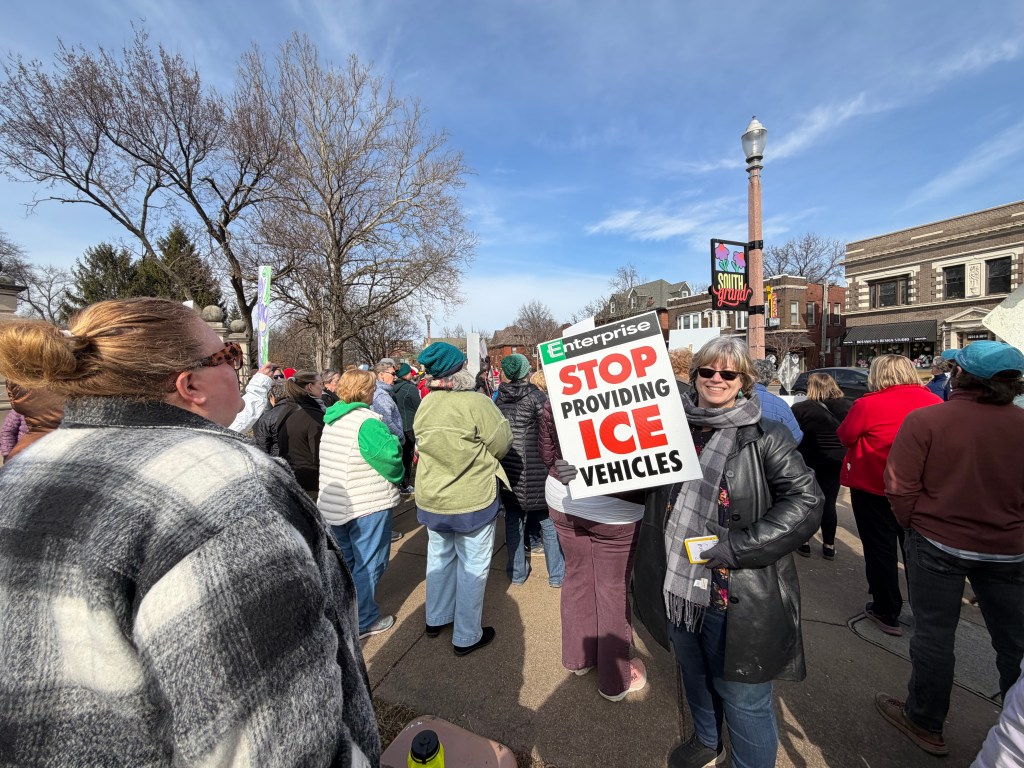
The singing protest in St. Louis was organized by a local chapter of the Singing Resistance movement which cropped up within the past few weeks, one of some 75 now across the nation. The Singing Resistance movement toolkit states: “Singing Resistance is a decentralized movement and we invite anyone to join us who is aligned around our core alignments and goals. We encourage people to create (or mobilize already-existing) singing groups in your local community and to organize song-based actions that are relevant to your context and to the political and historical moment we are situated in.” STL organizers chose to target Enterprise for renting out vehicles to ICE agents, because the company is headquartered in St. Louis. As such, they chose “Keep your eyes on the prize (eyes on Enterprise)” as one of their songs. The St. Louis action was far from the only one this past weekend. The Singing Resistance movement’s Instagram account had declared Feb 28 – March 1 a ‘Weekend of Action,’ and encouraged people to organize and participate in singing actions across the country. As local chapters of Singing Resistance flood their instagrams with videos from the weekend, it’s clear participation was high. From Chicago, to Cincinnati, to Philly, to LA, to a Target flash mob in Emeryville. It seems people are so excited to participate when actions are well-organized and enjoyable.
Protest singing is new right now and at the same time a completely ancient practice. Somewhere along the way in the United States, we stopped singing. The last time protesters in the United States took singing seriously on a mass scale was during the Civil Rights movement; MLK Jr. lauded the importance of freedom songs for the struggle. So it’s not surprising that a lot of those ready and eager to show up for the Singing Resistance – at least in St. Louis, according to my mom – are people in their 60s and 70s, who themselves were active in the Civil Rights Movement. But those showing up wanting to sing go far beyond that demographic. Protests in the US have been missing music, and people are really craving it. If you’ve gone to a protest in the past 10 years, you probably wouldn’t have noticed much, if any, singing. At best, there might be a lot of chanting, often cycling between the same couple tired refrains (we get it – ‘this is what democracy looks like’). But now the tides are changing, and fast. Momentum, a training institute and community of movement organizers, created a training module entitled “Why did we stop singing?” to encourage movement leaders to reintroduce singing in their activist spaces. What they’ve found from that module is a big appetite for singing and a lot of joyful participation. We’re relearning that songs are a key cultural ingredient of a healthy movement. The Singing Resistance carries potential to bring a lot more people into the fold, people like my mom who want to partake in collective action but hadn’t found such an appealing option on the menu until now.
Psychologically, singing in a group has tangible effects. Unlike chanting, singing immediately evokes an emotional response from the soul and just feels good in your body. It’s much more contagious, too – and a good tune will linger far longer in your brain and subconscious, which also applies to ICE agents being sung at. When you sing in a group, it gives you the sense that your voice matters for the larger whole, while viscerally assuring you that you’re not alone. The singing resistance finally addresses a core component progressive movements of the US have come to lack in recent decades. Dakota Hall dubs it ‘the fun deficit’ in this Substack post. It’s exactly what it sounds like, and it’s something I’ve absolutely experienced in my various attempts at collective action over the past several years. People need reasons to feel excited to take action in their community, not a sense of dread. We also need to drastically lower the barriers to entry, which these simple, easy-to-learn songs absolutely do. Resistance singing can become a huge step towards this much-needed culture shift towards truly inclusionary and enjoyable community action.
Not only does singing in community feel good, it’s a real, proven resistance strategy against violent forces. Freedom songs proved to unite and strengthen the anti-Apartheid movement in South Africa on its way to victory. Up in the Baltics, singing was also used as nonviolent protest to combat attacks from the Soviet Union. Known as “the Singing Revolution,” Latvia, Lithuania, and Estonia in the late 80s and early 90s continued their long history of resistance singing when Soviet forces tried to overthrow the newly-independent states. The nonviolent response of thousands of unarmed citizens singing in unison gave them a lot of moral high ground. The optics of killing such a group proved undesirable even to Moscow. According to Associate Professor of Baltic Studies Guntis Šmidchens, “From January to August 1991, Soviet special forces units targeted Baltic border posts, killing border guards in brutal displays of power, but they failed to provoke a violent response from the Baltic publics and governments. And in December of 1991, the Soviet Union was no more.” Importantly, Šmidchens notes that Balts worked to prepare for the worst as well, utilizing their European allies and acquiring combat training. Peaceful resistance singing is just one strategy of many that should be employed in times of violent occupation, but it’s a crucial one that should not be overlooked. Thankfully, it’s finally being embraced again.
We can now thank the people of Minneapolis for one more invaluable contribution to humanity: a return to resistance singing (even up there with the Milky Way bar).

 Clarity in Catastrophe
Leave a comment