
The story of the 2018 Camp Fire has come to Hollywood.
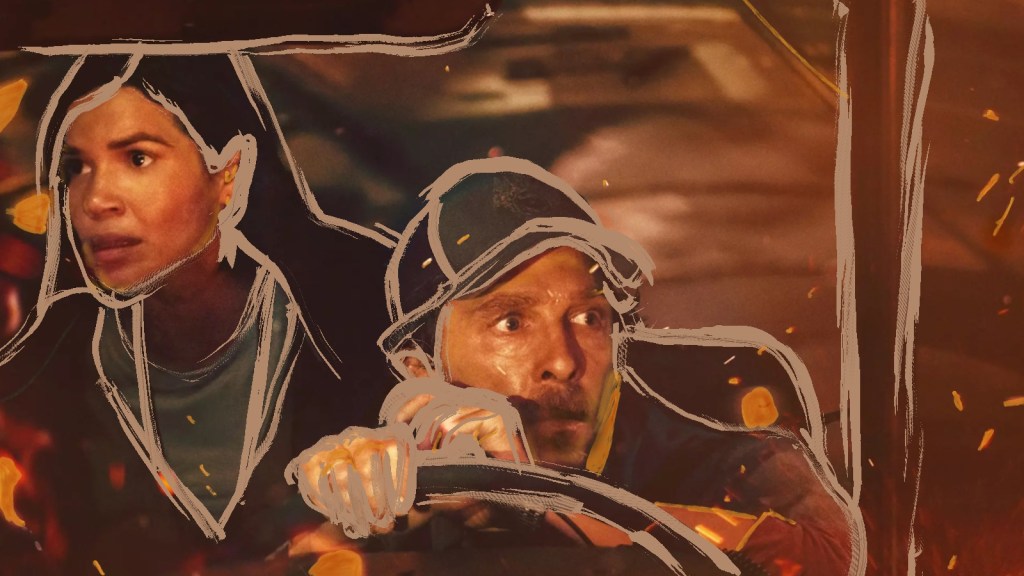
The Lost Bus has been described as a thriller, a real-life survival drama, and a disaster movie. It’s a zoomed-in story of the deadliest wildfire in California history to date. The 2018 Camp Fire killed 85 people and leveled the town of Paradise, raging for over 2 weeks and causing $16.5 billion worth of damage. The movie is based on a 2021 book about the fire by journalist Lizzie Johnson, Paradise: One Town’s Struggle to Survive. The particular vignette The Lost Bus focuses on is the harrowing journey of a bus driver, a teacher, and 22 second-grade kids on a school bus through their hometown-turned-fiery-hell in order to find the kids’ parents on the other side.
No one is calling it a climate film, but it obviously is that too.
Why we need climate on the big screen
Climate change exacerbated the 2018 Camp Fire by setting several of the conditions for catastrophe, including prolonged drought conditions, unseasonable heat, and extreme winds. With The Lost Bus, we get to see a real, recent climate disaster play out on our big screens, in full Hollywood glory. And that’s really important.
It’s important because film is an underutilized and incredibly potent avenue for telling climate stories and grappling with our crisis-ridden world. Anna Jane Joyner, climate story consultant, and Matthew Schneider-Mayerson, professor of English and environmental studies, co-authored a report about this intersection between films and the climate crisis. It covers how they define a climate film, findings from a thorough review of recent films, recommendations for writing climate into film and TV, and why it is so crucial to do so. They explain in 2024 for The Climate Pod that emotional storytelling is sorely missing in the climate space. It’s a missed opportunity because there are numerous examples of social change emerging from parasocial relationships with TV characters, subliminal messaging, and behaviors modeled through the screen. Contending with the climate crisis through film allows us to face reality while remembering that we are not alone. Hollywood in particular also reaches the masses, as well as across the aisle, in a way no other media can. And it does so while engaging our hearts and unwittingly casting aside our biases to connect purely as humans swept up in a story. In such a deeply polarized media state, this is a superpower.
Producer Jamie Lee Curtis, actors America Ferrera and Matthew McConaughey, and director Paul Greengrass have all spoken in interviews about how important and meaningful this film felt to make. They all, like most people in Hollywood, have personal experiences with wildfire themselves. Underscoring the urgent relevance of the film is the backdrop of the rebuilding from the Pacific Palisades fire that wreaked havoc earlier this year (where Curtis lives).
Assessing The Lost Bus as a climate film
The existential & the everyday
The beginning of the movie lays out the daily struggles of our protagonist bus driver, Kevin McKay. The film paints him as a representation of lots of people who called Paradise, California home at the time. He’s struggling to make ends meet, dealing with heavy stress and wrapped up in his shortcomings as a father, grieving son, and blue-collar worker.
The personal storyline and dialogues are not the strongest, but the choice to ground this movie about a devastating wildfire in the minutiae of everyday life struggles felt right to me. The climate crisis doesn’t exist in a vacuum, so I like that this climate event is positioned early on as simply the backdrop of normal life. We get to see the meeting of everyday drama and existential drama, which coexist simultaneously, but we don’t always see them collide. The climate crisis will always intersect with day-to-day struggles of survival. Most of us don’t think about climate change every day because we are too busy putting out the small fires of daily life. But it’s still there, ready to affect us and force us to face it eventually. This fact is viscerally felt with Greengrass’s portrayal of the fire as a monstrous character, creeping and roaring across the landscape, quickly infiltrating roads, homes, and taking lives. The climate crisis is a character in all our lives – a looming monster waiting to directly introduce itself.
The elephant in the room
In the climate and film report, a movie counts as a climate film if it passes two criteria: climate change is present, and at least one character knows about it. While the presence of climate change is clear, only one line qualifies The Lost Bus as a climate film. At a press conference as the fire raged, the fire chief spontaneously added this comment to his update: “Every year the fires get bigger. And there’s more of them. We’re being damn fools.” That’s it: the only passing mention of climate change, without even saying the C word.
It can be a climate movie without mentioning climate, but it’s an interesting question. To mention or not to mention? In an interview with The Globe and Mail, Greengrass explains his thought process:
“Yul and I talked a lot about it. Is that line too much or too little? You try to find the one moment to say something that is both appropriate to the story told – the character would need to feel it in the moment – but that it speaks to what a person watching this film inside would think, too. It’s not about wanting to make a film that is a lecture. You want a film to be an intense experience and a rewarding experience. All the things that make a movie worth watching. But if you can try to capture that thing that is just on the edge of people’s consciousness, then it gives your film a sense of relevance.”
I feel ambivalently towards calling the climate crisis what it is versus leaving it implied in this medium. But while the filmmakers insist the film is “not political,” the climate crisis is indeed very political. Politicians’ willingness to get in bed with oil and gas lobbyists has stalled climate action for decades, and keeps these horrible tragedies coming. And for what it’s worth, Anna Jane Joyner’s research has led her to believe that conservative audiences are becoming less turned off by climate’s inclusion in TV and films.
Personal reflections on facing disaster
Paul Greengrass’s style of directing makes it nearly impossible not to imagine yourself right there in the midst of the horror. Pure desperation. Car accidents and gridlock. No visibility of anything but smoke and fire. Surrounded on all sides by flames. Overheating and air pathways closing. No one coming to save you. Thinking you are certainly going to die. This portrayal is true to life. Lizzie Johnson told NPR that at one point, McKay “had the teachers make a manifest in case the only thing getting pulled out of that bus were bodies.” Also true to life is that they were stuck on that bus journey for nearly 6 hours, trying to travel just 30 miles to safety. The feeling of being trapped on that hell bus in dead-locked traffic translates palpably through the screen. That feeling of intense existential urgency to do something, while being unable to move at all, feels like the perfect metaphor for the climate crisis as a whole.
As the century goes on, more and more of us will be thrust into situations like this. As climate hazards become more frequent, extreme, and unpredictable, more of us will find ourselves at the center of a storm we never imagined we’d be in. So, I think it’s important that we do start to imagine what it’s like to be in these survival scenarios. Movies like this help us safely position ourselves there and allow us to think about how we would want to respond. Doing so is more productive than turning a blind eye and pretending this isn’t the world that we live in (while anxiety eats at us deep inside).
From this perspective of facing disaster head-on in the movie, a couple personal reflections came to me. The presence of looters served as a reminder that in all these disaster scenarios, there are heroes but there are also selfish opportunists. Survival brings out the best and worst of humanity. What kind of person do I want to be if and when disaster strikes my neighborhood? It also brought to mind a thought that when push comes to shove, rules and plans are useless. We see this tension play out in the contrasting approaches of bus driver Kevin McKay and teacher Mary Lugwig. Mary’s obsession with control and doing things by the book collapses in a dialogue near the end about how that approach to life didn’t save her from this situation. From both this movie and the 2021 documentary I watched after, Fire in Paradise, I left with the impression that we have to be willing to step up to the plate and bravely do what needs to be done, casting aside normal protocols or expectations for the greater purpose of saving lives. We’re inhabiting a world that becomes less fair each day, as rules are re-written – massive, growing wealth inequality; fascism on the rise; an increasingly unintelligible climate system. In such a confusing, unjust time where the system is rigged, we have to trust our instincts about right and wrong. Playing by the rules won’t always save us.
Lessons on disaster preparedness
Another hard truth of this film is that plans fail, especially when they don’t take the climate crisis into account. There are several lessons to be learned for the disaster preparedness sector from the failures of the Camp Fire.
The list of circumstantial failures is extensive. 1) PG&E opted not to shut off power that morning, a tool they can turn to on high wind days to reduce wildfire risk. 2) PG&E negligence allowed an aged electrical transmission tower to ignite the fire, when a 100 year-old iron hook snapped, releasing a high-voltage cable into the exceedingly dry brush. 3) When first spotted, the fire was manageable but was by a narrow dirt track too dangerous for firefighters to get to, so it spread. 4) The wind was too strong for aircraft to put out the fire. 5) Firefighters had to immediately enter rescue mode when the fire spread to Concow, and had to abandon intelligence sharing because of how quickly the winds exacerbated the situation there. Therefore, Cal Fire didn’t know how fast it was spreading into Paradise until it was too late. 6) They didn’t prepare an evacuation plan for a fire that would come from all sides. 7) The roads weren’t big enough for so many people to evacuate at once. As for the climate contributors, there was no rain for over 200 days and the landscape was critically dry, plus there were extremely strong winds. As is often the case with wildfires these days, including the January LA fire, poor land use and vegetation maintenance decisions amplified the danger as well. All of these failures combined led to the loss of 85 lives and an entire town.
Watching the Fire in Paradise documentary, I encountered this sentiment time and again: that this fire was so desperately unprecedented in its force, speed, and scope, that no one saw it coming or could have prepared. The unprecedented nature of the fire is inarguable: in just an hour and a half, it traveled 7.5 miles. It moved at a rate of 80 football fields a minute.
But to be honest, I found this position very frustrating – that no one could have foreseen it. As Director of Stanford’s Climate & Energy Policy Program Michael Wara states in the doc, “We have had a number of fires over the last several years prior to the Camp Fire that had some of the characteristics – in particular, the rate of spread and the total ineffectiveness of any kind of suppression effort.” This is the world we live in now. If resilience and survival is the goal, we have no choice but to ‘expect the unexpected.’ We have to understand that each disaster is more and more likely to be worse than the last. We have to wake up to the climate crisis that is now the backdrop of all our lives.
The Camp Fire is a story of human and institutional failures, which is to say a story we all know and can relate to. Our work is cut out for us to prepare better.
Who’s at fault?
While multiple factors coalesced into such a catastrophe, there is a bigger picture of who is most to blame. Weaved throughout the film is the latent narrative that PG&E is primarily to blame for this tragedy. The moviemakers have the luxury of confirming this narrative outright at the end of the movie, with text summarizing the outcome of a lawsuit against PG&E. We learn that PG&E in fact pleaded guilty to 85 counts of involuntary manslaughter and paid more than $13 billion to victims from the fire. The documentary goes even deeper into PG&E’s culpability, including that the company had dramatically cut back on inspecting and repairing power lines for decades and willfully chose not to address its aging infrastructure. We do need more climate disaster movies that continually redirect our anguish towards the corporations at fault, like PG&E. This one serves as a great example for that. Next we need more movies that directly take on oil and gas corporations themselves, telling the stories of the numerous lawsuits in progress against those beasts.
Finding the right tone
Striking the right balance between facing hard reality and retaining some hope is not an easy feat. The Lost Bus proves that a movie can be difficult to watch and at the same time be rewarding. It was a wild, distressing ride, but it didn’t feel punishing. Though a rollercoaster of dark emotions was felt, my emotional state never reached bleak abdication to a world beyond hope. It’s critical to tell these stories in a way that keeps the audience engaged and not checked out. Avoiding both sentimentality, with its “trite solutions and simple tropes” as well as “bleakness, nihilism, and despair” was paramount to Greengrass. To me, that is a successful climate movie. Seeing the extent of real human resilience (not the fairytale superhero kind) is always deeply inspiring, too.
Paul Greengrass offers that The Lost Bus is also about last chances or second chances – “because that’s kind of where we are, really, in a burning world, is ‘Is it too late?’ or do we get a second chance to fix it?”

 Clarity in Catastrophe
Leave a comment