
Today is June 5, 2025. For many, that means summer break is quickly approaching. Work loads starting to lighten, schools closing for the season, temperatures rising, the days lengthening. Prime time for travel. Family vacations, trips with friends, solo excursions to the destinations you’ve been dreaming about all year.
5 years ago, we were deep into a global pandemic. For a lot of us around the world, it was a summer without travel at all. Covid-19 brought the tourism industry to such a screeching halt that many wondered if it would ever bounce back – if people would ever travel like they used to. Well, those concerns have officially been put to rest: international tourism returned to pre-pandemic levels (99%) in 2024.
If a global pandemic can’t permanently weaken our magnetic pull to travel the world, it seems nothing can. As long as people have the ability to jet-set across the globe, we will do so.
But is that a good thing? What are the implications of this booming, virtually undeterrable global tourism industry?
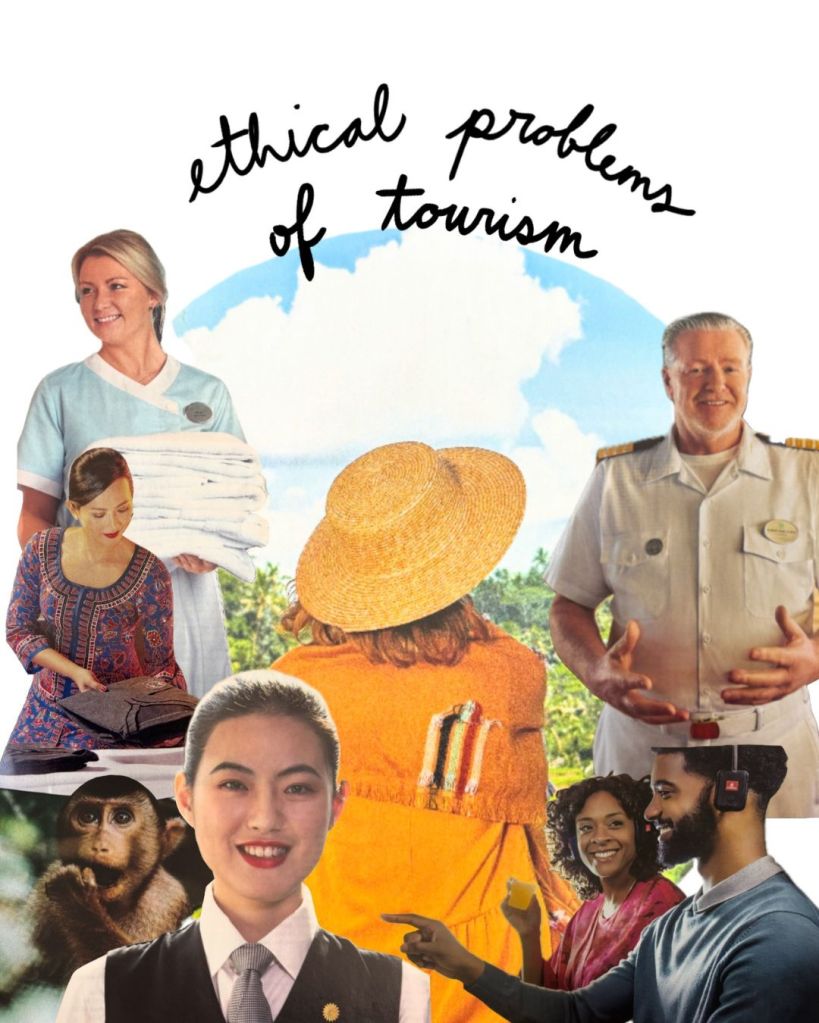
Ethical problems of tourism
Gentrification gone global
Gentrification is a complex process, but its essence entails the character of a place undergoing huge identity changes due to an influx of wealthier residents and outside investments. In effect, this often means loss of culture. It looks like residents of a place with a long history of certain people and cultures building their home there, being priced out of that home as outsiders come use their money to assert their own influence. It changes the essence of the place and displaces long-time residents who can no longer afford to live there.
Normally, gentrification is discussed in a neighborhood-level context, or even certain cities that have experienced so much gentrification as to change the overall identity of the entire municipality. It turns out, the boundaries of gentrification are nonexistent. Gentrification has gone global.
According to the World Travel & Tourism Council, the tourism industry’s contribution to global GDP in 2024 totaled 10.9 trillion USD. Just like how outside investments in gentrified neighborhoods do not financially enhance the lives of long-time residents there, neither do the riches of tourism tend to enhance the lives of locals. Economic leakage describes the way that money raised by tourism does not return to the local economy, but rather leaks out to outside sources. Currently most of the tourism industry’s profits are going to corporations and foreign investors. If you think about these common sources of leakage, it’s easy to see how all this money gets diverted: foreign-owned airlines, car rentals, insurance companies, travel agencies, hotels, resorts, tour operators, shops and restaurants, and imported goods and services. All-inclusive (foreign-owned) hotels have the diversion of profits away from the local economy built into their operations.
This 2024 report “Creating Equitable Destinations,” estimates that of every $100 USD spent by a tourist from a developed country on a vacation tour in a developing country, only around $5 USD on average stays in that developing country’s economy. Tourism leakage is estimated to be between 50% and 80% of total tourist spend, especially in the least developed countries (where you can imagine the money would go the farthest, if invested back into the economy).
Locals displaced & neglected
These patterns ultimately lead to the displacement of locals. More investment and development causes prices to inflate if unchecked by the government, as often is the case with the cash cow of tourism. The consequential impact on housing prices is the most felt. Skyrocketing housing prices in Hawai’i is directly related to the outcome that the majority of Hawaiians (55%) now live outside of Hawai’i rather than inside the island, according to 2020 US Census data.
When investment comes from outside, suddenly outsiders have more say than locals over what happens in the locals’ home. With the shifting of money inevitably comes the shifting of power. When foreigners dictate development and land use decisions with that newfound power, tourists’ desires become propped up at the expense of locals’ needs. Local quality of life becomes degraded as they compete for limited resources with tourists. Water scarcity is a big issue in many popular tourist destinations. When supply is limited, luxury hotels win out over the local population. This has negative impacts even beyond isolated water shortage events. Remember the 2023 wildfires in Lahaina, Maui that killed 102 people? For years prior, much of Maui’s water was diverted away from communities like Lahaina and toward new hotels and golf courses. That localized dryness amplified the devastation of those fires on the local communities living there.
Outsized influence of foreign investment also paves the way for the creation of tourist spaces that are even off-limits to locals. Jamaicans actually have no legal right to access their own beaches. Even some eco-tourist activities, like many safari tours, have displaced Indigenous communities, under the guise of conservation but really for the enjoyment of tourists at locals’ expense. Some farmers get evicted from their own farms so the land can be used for safari tourism. In Cambodia, the government leased 20% of Cambodia’s coastline to a Chinese development group for resorts and golf courses, evicting citizens from their fishing villages. Relentless tourism shaping daily life more than the people who live there year-round leads to locals “feeling like extras in their own movie.”
Thanks for being here! Clarity in Catastrophe is a reader-supported publication. Please consider becoming a free or paid subscriber.
Extraction
Of environment, of culture
The tourism industry inherently wants to extract from local environments and cultures for monetary value. This commodification can turn something beautiful – travel – into the cold, soulless, artificial experience of tourism, flattening the rich complexities of place, ecology, and culture. Because of this trend, a lot of travel doesn’t actually break down cultural barriers, but exacerbates and capitalizes on cultural misunderstanding. The commodified, sanitized transformation of ancient spiritual practices like hula for the gaze of outsiders is one example. The performance of culture as entertainment that fits an outsider’s taste, rather than engagement with the real thing – that’s extraction. “Tourists are usually shielded from the reality of the countries they visit and served a pre-packaged product meant to serve their preconceptions.”
Climate impacts
One cannot travel far without contributing to planet-warming emissions. Tourism accounts for 8% of global GHG emissions, about half of which is from transportation.
Flying is one of the most controversial topics when it comes to the climate crisis. Air travel contributes an estimated 2.5% of global annual CO2 emissions. It is one of the most carbon-intensive things you can do, making a much bigger impact than nearly any other individual climate action a person can make. I’ve heard the argument made many times that it is simply unethical to fly due to the emissions released. That therefore, we will have to fundamentally change the way we travel and engage with the world around us. There are obvious merits to that, but for lots of people, the idea of sacrificing travel is entirely unappealing.
Even if the travel industry could feasibly dissipate, I don’t believe the answer to the climate crisis and a better world is to not travel at all. For one thing, telling people not to travel dissuades those who would actually be ‘good’ (more conscious) travelers. And it would be too simplistic to discount the myriad other benefits of travel.
Benefits of traveling
Traveling can provide much needed funding for ecosystem restoration and conservation (like Costa Rica has done so successfully), increase awareness of global issues, increase empathy towards other cultures and people, enrich people’s lives, spread knowledge and ideas, boost creativity, improve mental health and reduce stress, inspire, enhance communication and social skills, broaden worldviews, sharpen problem-solving skills, and so much more. These are not things worth throwing away, and I don’t think there’s a shortcut that can provide all of these benefits.
What individuals can do
Individuals can help shrink this gap between the current realities of tourism and the blessings of travel. Decide thoughtfully where to travel, spend your money there wisely, and behave like a considerate person while there.
Deciding where to travel
Consider traveling to low-income countries
In this powerful Ted Talk, Christoph Winter advocates for travel to low-income places that are disproportionately affected by poverty rather than to high-income regions because you can make a much bigger positive impact on people’s lives there. As evidence, Winter presents a study, “Subjective Well-Being & Income: Is There Any Evidence of Satiation?” which shows that across several countries, life satisfaction rises by about 0.3 points whenever income is doubled. Of all regions in the world, Europe has long had the largest share of international tourists – by far – and Africa has long had the smallest portion, not even close. There’s a clear opportunity here to start to redistribute the world’s riches to the regions that stand to benefit the most. Just as convincing, Winter reminds us that we have evolved to favor and empathize more with those who are like us. By changing our environment and the people we spend time with – even if just for a week-long trip – we can start to correct this hard-wired bias and feel more connected to those seemingly unlike us on the other side of the world.
I find this the most convincing moral argument for how to travel as a force for good. I also suspect it’s the suggestion least likely to be adopted because it probably involves moving firmly outside your comfort zone. It’s worth acknowledging that many people who travel do so in order to relax and feel comfortable, not go out of their comfort zone and experience new cultures and people. I’d argue for taking baby steps in the direction of this suggestion and looking for a happy medium; leaving your comfort zone is how we grow not only as individuals but also as a society. But even if you don’t want to switch your destination to a low-income country, there’s still so much you can do to ensure more ethical outcomes from your decisions while traveling.
As a bare minimum, we can choose not to travel to countries that blatantly disregard human rights. Like Qatar, which has infamously heavily exploited and coerced migrant workers for its labor force, notably allowing thousands of migrant worker deaths during the construction for the 2022 FIFA World Cup. While no state is perfect, some are far worse than others and their actions should not be emboldened with tourism dollars.
How to get there
If flights are necessary for your trip, flying direct emits much fewer emissions than multiple flights with layovers. If possible, opting for slower travel methods like trains is so much better for the climate and often offers a much more relaxed and scenic experience.
Avoid cruises at all costs. Cruises are horrible for several reasons. Cruise ships emit various types of pollution, water displacement, and are terrible for air quality, all harming ecosystems and risking public health. The carbon footprint of a cruise ship is more than 12,000 cars. They are far worse per kilometer of carbon emissions than someone traveling the same distance by plane, plus staying in a hotel. They’re also petri dishes for disease and were pretty much the worst place in the world to be when Covid-19 hit. If you’re still not convinced, almost none of the big cruise lines pay corporate taxes. For shorter distances, ferries are a great alternative to cruise ships because they generate less waste and pollution. River cruises and sailboat cruises are more sustainable options, too.
Of course, take public transit when possible, and opt for electric vehicles when a car is needed.
Spending wisely
There are so many things individuals can do under the umbrella of spending to shift from supporting gentrification and displacement, to supporting locals. Shopping local is the simplest and most effective way to do this. Put as much of the money you spend as possible into local businesses. It does require forethought and planning, since so much of the most obvious tourism infrastructure is not built to support the local economy.
Instead of basing all your decisions on social media virality, look to local guides, community leaders, cultural experts, and content creators for what to do there and how to support locals.
If you choose to stay in a hotel, choose a locally-owned one. Even better, stay in an eco-hotel if that’s an option. Beware of greenwashing – the term ‘eco tourism’ can mean anything, and often means nothing. Even if it misses the mark for sustainability in some ways, supporting hotels that brand themselves as sustainable (and have at least some real actions behind it) sends a market signal that there is demand for that.
Behaving thoughtfully
It’s self-explanatory, but the following simple things while traveling can hugely impact the daily experience of locals, especially in high-tourist areas. Leave positive reviews for local businesses; haggle fairly; mask on planes to prevent the spread of disease; educate yourself on the place’s cultural norms: local laws and etiquette, tipping culture, sensitivities, regulations at sacred, natural, and cultural sites, historical context, conservation efforts, and dress code; learn a few phrases in the local language; abide by customs and traditions; reduce the personal waste you create and conserve energy and water.
What the state can do
While individuals have a lot of power in their travel decisions, the state has the most control over regulating industry and setting up the correct incentives and enforcement mechanisms to truly enable tourism to be a force for good.
States can:
Diversify the local economy so it relies less on tourism to make sure that locals have a stronger say in the place they call home than outsiders do. Encourage travelers to come in the off-seasons and to visit similar, less popular destinations to minimize the negative impacts of overcrowding. Strengthen infrastructure to be able to support the amount of tourists they allow. Prioritize the needs of displaced and financially stressed locals over the desires of the tourism industry. Offer financial assistance to locals who have been pushed into homelessness by tourism-induced gentrification. Place regulations on Airbnb and other short-term rentals to keep housing crises at bay. Restrict short-term rentals or second homes, and make sure what’s built by developers is actually affordable for residents. Ensure labor protections in the hospitality sector so the locals working to give tourists an amazing experience for often meager pay can themselves enjoy a higher quality of life. Redistribute more of the money the government does make from tourism back into the local economy.
Done right, traveling can be huge a net force for good in the world. If all the money generated from tourism in 2024 went right back into the local economies – if economic leakage was zero – that’s an order of 5.5 – 8.8 trillion USD. That would be life-changing for the people living in those places. That kind of money can also be used to make regions more climate-resilient, in a time when developing nations are falling short of the trillions they need for climate mitigation and adaptation. Achieving this goal requires determined action from both individual travelers and states.
Thanks for reading Clarity in Catastrophe! If you liked this post, please share it.

 Clarity in Catastrophe
Leave a comment