
When you think about the changing climate, do you feel the joy of potential societal transformation, or do you feel despair and hopelessness?
Chances are it’s the latter, especially if you’re Gen Z.
Climate hopelessness is an epidemic.
Pessimism is at an all-time high, among young people especially.
Every way you slice it, data tells us that Gen Z is both uniquely depressed and uniquely pessimistic about the state of the world. In the 2023 book Generations by Jean M. Twenge, Twenge pores through data that all point to social media being the primary reason for this. Along with all the other psychological challenges social media brought to teens, social media becoming the default source for news has distorted our brains. Media has always been biased towards negative news, but social media has exploited that bias to great effect. Algorithms encourage and proliferate rage bait and doom bait because it’s what generates the most traffic and engagement, while the most innocent of topics mushroom into the latest polarized locus of the culture wars.
Amidst this backdrop, climate doomism is in fashion. Climate doomism is a mental orientation towards the climate crisis that is characterized by fatalism. It views the crisis as too late, or impossible, for us to solve, and complete destruction of humanity as inevitable. A 2021 study found that 32% and 33% of UK Millennials and Gen Z, respectively, feel that changing their behavior to address climate change is pointless and futile (more than 10% higher than older generations).
But it’s not just Gen Z. Another survey found that 14% of Americans wrongly believe that it’s too late to do anything about climate change. A 2023 study by BEworks found that globally, “nearly half of individuals feel helpless and overwhelmed by the climate crisis and their ability to take action.”
Doomism: not to be dismissed?
If this perspective sounds problematic, it is. It’s hard to address a problem when so many people feel helpless and hopeless.
Doomism isn’t to be fully dismissed, though, because it is partially grounded in truth (which is what makes it so dangerous).
The feelings underlying climate doomism are completely understandable. Sometimes, depression is a natural response to the world around us. Sometimes, depression is not a pathology to be fixed but rather a clear vision of a backwards society.
Given the track we’re on now (2.7 C of warming), and how much has already been lost due to the climate crisis, actually reckoning with this reality is sure to fill you with grief: for the species lost, the species and ecosystems we are destroying every day, the people and cultures ripped away, and the immeasurable pain to come, because we won’t be able to stop the coming disasters caused by the emissions we’ve already burned.
We should not sugarcoat the truth. Addressing the climate crisis requires mass agreement of the urgency of the problem.
The science of emotions and effective messaging is decisively indecisive. That’s to say there’s no clear evidence that fear is always a helpful or unhelpful messaging tactic. Doomism is certainly based in fear. In some situations, like the livability of our only home, fear is undoubtedly warranted.
So what’s so bad about doomism?
Doomism: a dark delusion
There’s a fine line between realistic pessimism and doomism. The valid feelings described above come from a natural pessimism earned by the state of the world and the challenges facing climate solutions. Doomism is another thing entirely. Yet, climate pessimism is vulnerable to all too easily slip into doomism. How has it happened at such a large scale?
Dark origins
Climate doomism has been fed to us – purposefully, with mal-intent.
Every time I read or watch something related to climate and I look at the comments, I see, without fail – no matter how hopeful or balanced the content – a decent amount of comments like these:
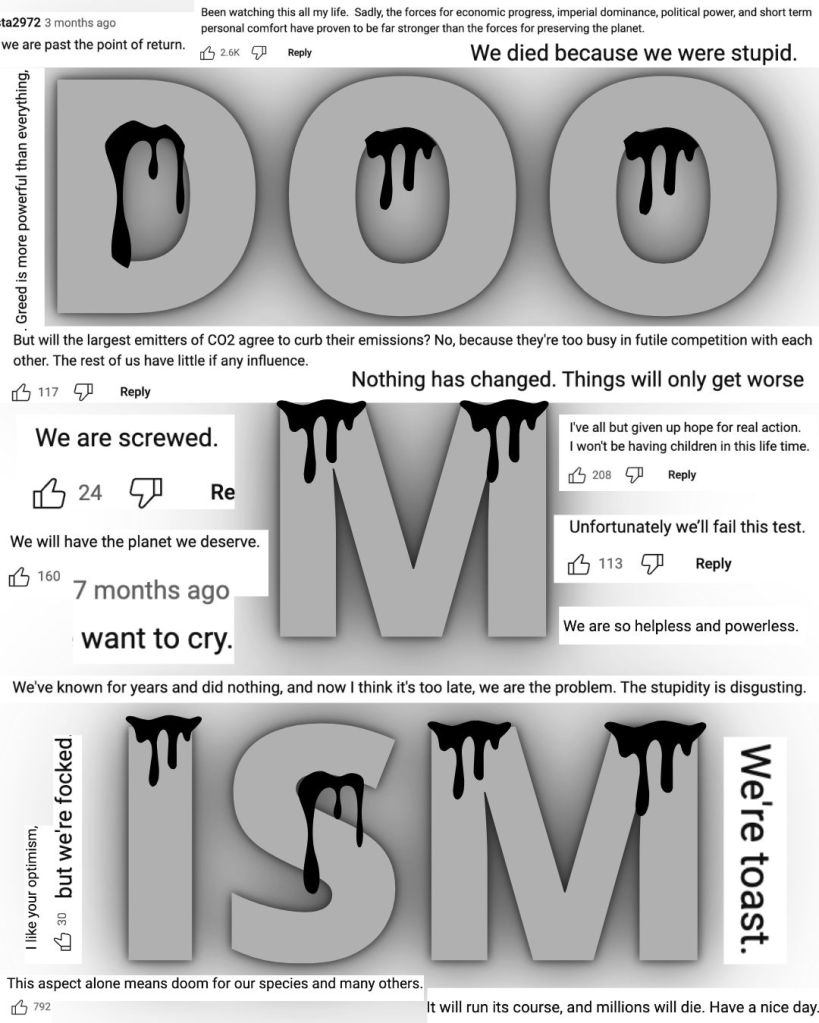
A popular climate education Youtuber, Simon Clark, noticed this too. Detecting a recent shift, having been in this niche for several years, he decided to survey the 12 most popular climate Youtube channels to see if they shared in this observation. Clark documented that over the past 2 years, these channels have seen an increased frequency of comments that reek of doomism. Before, these types of comments weren’t as common; instead, they had the mark of climate denialism. In essence, those who once poked holes in climate science itself (deniers) now put their energy toward arguing that the solutions to climate change are harmful, pointless, and expensive, so we shouldn’t try (doomers). (Simon Clark). This phenomenon is validated in a 2024 Center for Countering Digital Hate report entitled “The New Climate Denial.” The report sheds light on entire channels that have shifted from ‘old denial claims’ to spewing ‘new denial claims,’ aka doomism. As Clark explains, this evolution of messaging to stymie climate action is consistent with the tactics used by the smoking industry: first, deny the science; once that’s no longer possible, poke holes and doubt in the solutions and shift blame everywhere else in order to keep racking in profit for as long as possible.
Clarity in Catastrophe is a reader-supported publication. To receive new posts and support my work, consider becoming a free or paid subscriber.
Delusion
Doomism is delusional. It pretends that the future is a foregone certainty that could not possibly be affected by what we do in the present.
I’ve seen two flavors of climate doomism. One says that we are doomed because the medicine is worse than the disease (a pretty obviously deranged notion that addressing climate change will make us worse off than doing nothing). The other, however, is more nefarious due to its subtlety and the grain of truth it holds. It says ‘look at everything terrible that’s happened in history. the bad guys always win, don’t they? fighting the good fight is a nice story, but in the real world, greed and stupidity always win out.’ (While not true, it’s an extremely tough argument to refute, especially in today’s news ecosystem.) One subtype of this even conflates this human inclination toward self-destruction with all of humanity, an inherent fault we’ll never be able to overcome.
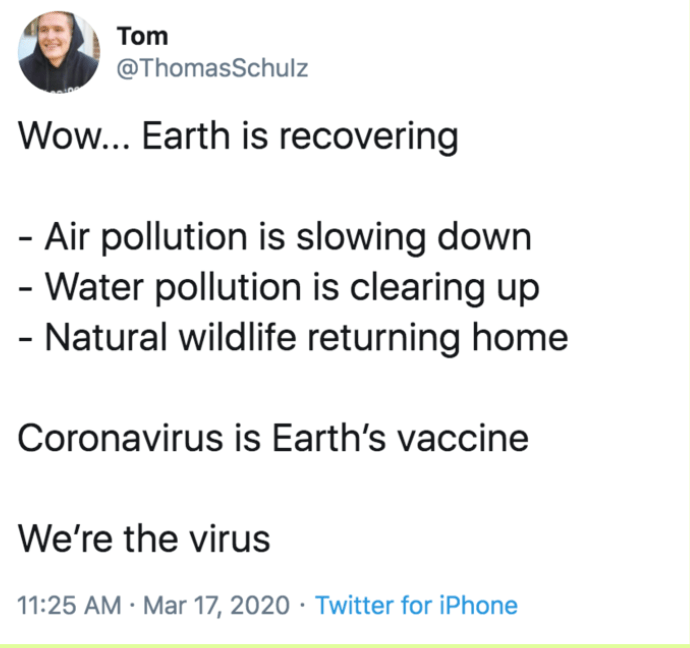
It’s worth addressing this self-flagellating notion that humans as a whole are bad for the earth. Braiding Sweetgrass is a book by Robin Wall Kimmerer that is rightly exalted in many environmentalist spaces. It’s chock full of Indigenous wisdom and lessons about how to heal the world and ourselves. On several occasions, she puts to bed the concept that humanity could never be capable of responsibly caring for Earth. Here’s one Creation story Kimmerer shares – a perfect allegory for the opportunity of the climate crisis:
“The twin grandsons of Skywoman had long struggled over the making and unmaking of the world. Now their struggle came down to this one game. If all the pits came up black, then all the life that had been created would be destroyed. If all the pits were white, then the beautiful earth would remain. They played and played without resolution and finally they came to the final roll. If all came up back, it would be done. The twin who made sweetness in the world sent his thoughts out to all the living beings he had made and asked them to help, to stand on the side of life. Tom told us how in the final roll, as the peach stones hung for a moment in the air, all the members of Creation joined their voices together and gave a mighty shout for life. And turned the last pit white. The choice is always there.”
Naive optimism is widely understood to be foolish, but naive pessimism is just as delusional and dangerous. How can you possibly make a better future if you have already decided it’s not in the cards?
Hope is a choice
Yes, humans are capable of unspeakable destruction. And the flip side is just as true. As Kimmerer shares, “The choice is always there.”
People say that love is not just a feeling, but a choice. Well, the same is true for hope.
Fossil fuel companies and all those profiting from the climate crisis want us to feel powerless. Feeling powerless is exactly the same as actually being powerless. It doesn’t matter how much agency you have if you don’t realize you have it. The disastrous status quo feeds off our hopelessness, which lulls us to sleep in the movie of our own lives and futures.
Optimism vs Active Hope
Optimism is looking on the bright side and believing that everything will turn out for the best.
Real hope is not wishful thinking. Real hope does not sugarcoat things or ignore the feelings of despair. Real hope is not passive. Real hope is grounded in action. Real hope saves room for grief, but keeps going anyway. Real hope knows that agency is always available to make the world a better place, if acted upon. Real hope is strategic.
Choosing hope just means each of us internally making the decision to not ever, ever give up on building a safer, more just, happier, and healthier world, and living our lives accordingly to chase that goal.
How to generate hope
Since hope is an action, it is possible to become more hopeful. Through action, yes, but once you act out hope, you’ll find that you start feeling more hopeful, too. Here are four ways to generate hope.
Watch what you consume
Curating a balanced media diet is really important to counteract the negativity bias too many of us have developed. One source I recommend is the Good Good Good Newsletter. If you are prone to climate hopelessness, regularly remind yourself that it’s not all bad; there’s plenty of good happening in the world. “For every public, pro-fracking speech, there’s a local community fighting to keep oil barons off their land; there’s an NGO like ClientEarth quietly leading lawsuits to hold governments accountable; there’s a group of youth activists fighting in court to defend their right to a clean, habitable environment” (Atmos).
The mind is beautifully malleable and impressionable. What you pay attention to and surround yourself with is what becomes your reality. If you look at solutions more than scary scenarios, you’ll start to naturally focus more on the solutions and the positive potential they embody.
Practice nuance
In Generations, Jean M. Twenge notes that depression often involves cognitive distortions. Since such a large chunk of Gen Z in particular struggles with depression, we should understand the way that cognitive distortions shape how people view society. These include: negative filtering (focusing almost exclusively on the negatives), discounting positives, and, notably, dichotomous thinking, or viewing things in all-or-nothing terms. All three lend themselves well to doomism. Knowing this, practicing nuance as a habit becomes imperative, if avoiding climate doomism is your goal.
Nourish your creativity
In the same BEworks study that found nearly half of people globally feel helpless about the climate crisis, creativity was found to be correlated with hope and motivation. Having a creative mindset was defined as having higher creative self-efficacy, higher creative identity, higher likelihood to engage in creative problem-solving at work, and higher engagement in creative pursuits outside of work. Having this creative mindset predicted future-oriented thinking, perseverance, open-mindedness, and opportunity spotting, all incredible skills for addressing the climate crisis. “While many people see climate change as a fixed catastrophe, creative minds see a story still being written and can imagine many different endings” (Solitaire’s Storytelling). You don’t have to be an artist to become this person. Everyone is capable of fostering a creative mind.
Take action
Taking tangible action, no matter how small, is always the most obvious and effective way to cure hopelessness. This is why:
- Action shapes beliefs, not the other way around. Doing things that reinforce the world you want to live in signals to your brain that that world is possible, because why else would you be investing in it?
- Action leads to efficacy. The more you see your actions have an effect on the world, the more confident you become. It’s emotionally gratifying, which makes us want to do more. Local, community-based, grassroots action is where we can see the most wins for our climate efforts. The more obstacles you overcome, the more hopeful you become, because you’ve proven to yourself that change is possible.
- Action is contagious. The more visibly we act on climate solutions, the more those actions spread until they become social norms. The more people acting, the more progress we make.
Practice emotional resilience
In a video entitled “The Hidden Political Power of Hope,” Ahsante Bean insightfully details how to ward off the greatest threats to hope, and how much emotional resilience is needed in that process. Another word for climate doomism is despair. The 3 dangers of despair are 1) standing still, 2) self-pity, paranoid victimhood, and social withdrawal, and 3) lashing outward in hatred, rather than putting energy towards solutions. All three zap energy away from progress and sabotage hope. Practicing emotional resilience and emotional detachment from outcomes allows us to recognize disappointment while avoiding despair, or doomism.
Thanks for reading Clarity in Catastrophe! If you liked this post, please share it to help get the word out.

 Clarity in Catastrophe
Leave a comment