
It’s Climate Week in San Francisco, and I’m reflecting on what I find the hardest thing to explain to ‘non-climate people’ (aka, people who don’t frequently think about their work and life through the lens of climate). How bad is it really / how much progress are we actually making?
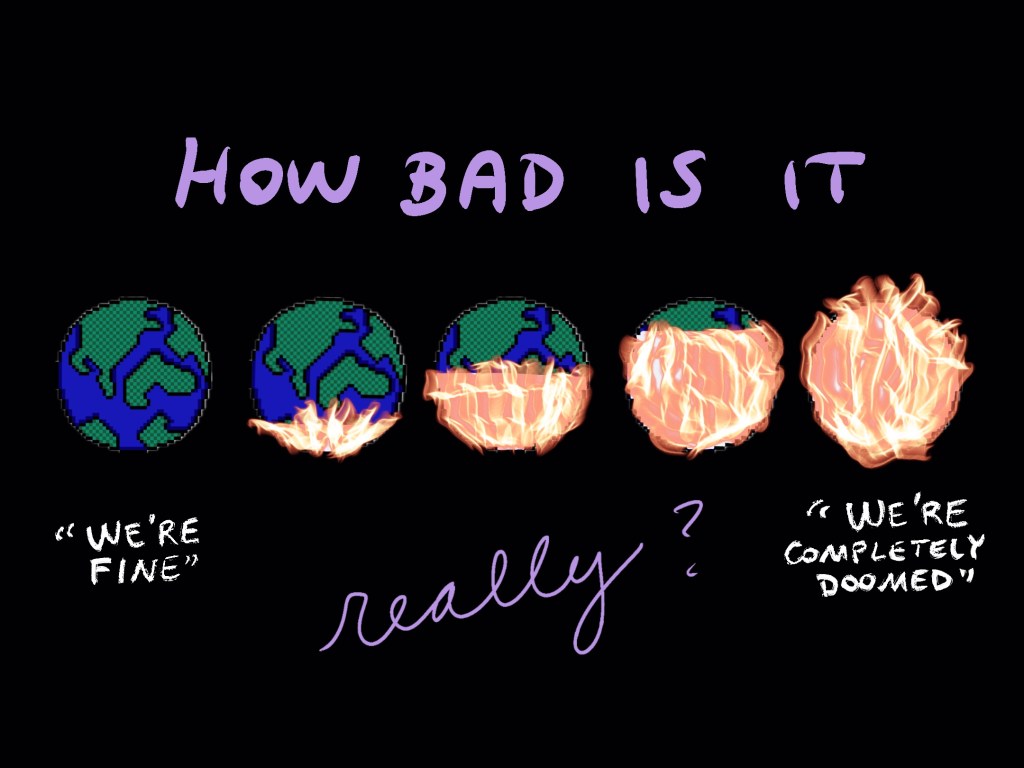
With flashy headlines and vested interests pushing one narrative or another, it’s easy to adopt a skewed perspective on how exactly we’re doing on the climate problem. Maybe you’ve taken the climate doom bait as I first did, believing that we are powerless to evade complete destruction of our species by the end of the century. Or maybe you’ve been persuaded that we’ll be 100% fine because some developing technology like carbon capture and storage (CCS), or hydrogen power, or even AI will swoop in and save us at the last second. Either end of the spectrum is not only wrong, but dangerously reductive. The only correct and productive perspective on climate is a nuanced one, if we are to continually choose the transformative path we need to be on for this issue.
Why is having an accurate understanding so important? Because our perspectives translate to our behaviors. If we believe climate is being handled just fine and we are on track to address the crisis in a timely way, we will sit back and not get involved. And if we think there’s nothing that can be done, well, why would we waste our energy to try?
For that reason, it’s our collective and individual responsibility to face the truth – without over-sensationalizing it.
So given that it’s not 100% doomed nor 100% fine…where do we actually find ourselves, right now, on that spectrum?
It’s not overblown: it actually is that bad
The climate crisis is not just another doomsday scam. The world is barrelling into uncharted territory for human civilization since the last Ice Age (more than 10,000 years ago). For all this time, we’ve been able to thrive because we’ve been operating within a stable climate. Here’s how far we’ve moved out of that stable climate range since we started burning fossil fuels:
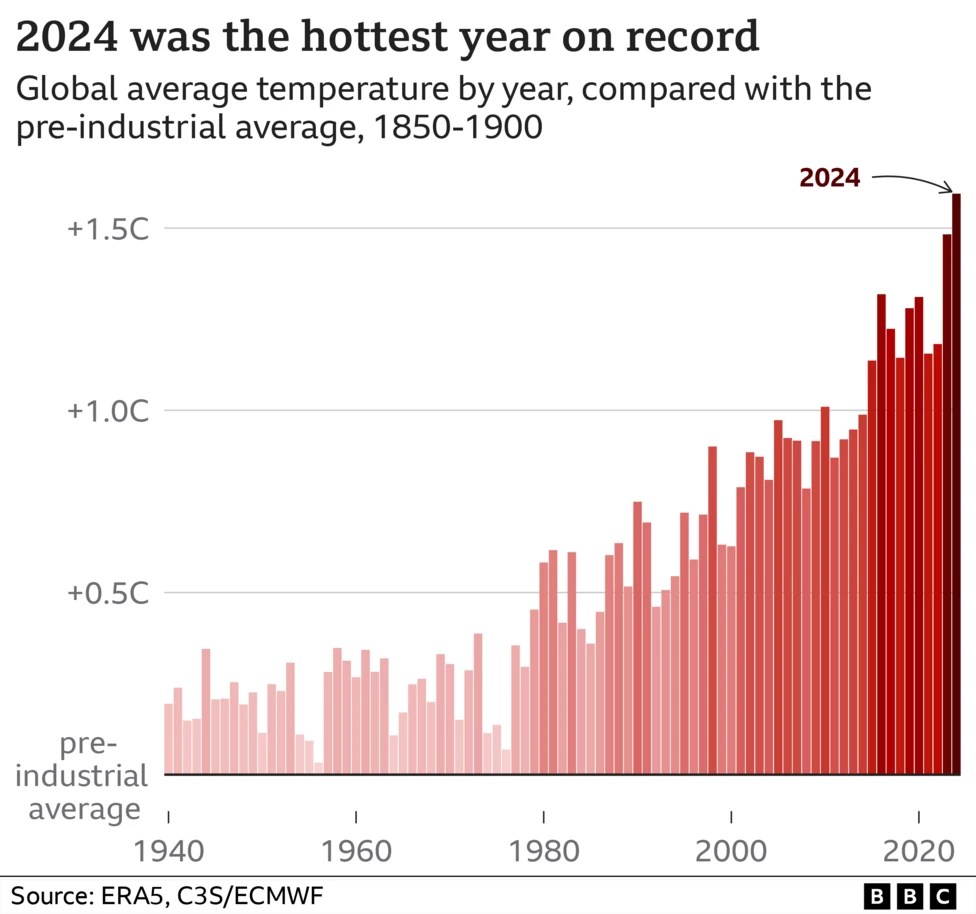
As a result of fossil fuel burning, greenhouse gases (responsible for our warming planet) are currently at the highest levels in the last 800,000 years (WMO State of the Global Climate Report).
The horrific impacts of fossil fuel burning become clearer every day – look no further than the weather channel. Each year takes the previous year’s place as the hottest ever recorded. Record-breaking destructive events have filled the news incessantly for years, on virtually every weather-related metric, across the globe: longest heat waves in history, most billion-dollar disasters in a single year, highest levels of torrential rain, number of mega-fires, just to name a few. Wildfire season is now year-round instead of occurring within a predictable time frame, and have been burning about 5% more land each year since 2000. Just last year, climate hazards “led to the highest number of new displacements recorded for the past 16 years, destroying homes, critical infrastructure, forests, farmland and biodiversity.”
In 2024, the global average temperature surpassed 1.5° beyond preindustrial levels for the first time. (Reaching a global average temperature of 1.5 C will become official once it’s the average temperature over 20 years, but we are definitely on our way.)
The 1.5 number sounds pretty meaningless without understanding what specifically is at stake. There’s a lot of uncertainty in projecting what the world will look like (again, uncharted territory), but here’s what can be expected with medium to high confidence right now, according to the UN.
If the planet becomes 1.5° Celsius warmer, this would happen:
- 1-10% of Earth’s species will go extinct
- coral reefs will diminish by 70-90%. Over a billion people depend on healthy reefs (NOAA).
- extreme hot days will become on average 3°C warmer at mid-latitudes (regions outside the poles and tropics)
If warming reaches 2°C instead of 1.5,
- extreme hot days could become on average 4°C warmer at mid-latitudes (regions outside the poles and tropics)
- several hundred million more people will be exposed to climate-related risks and susceptible to poverty
- 10 million more people could be exposed to frequent flooding events
- more than 99% of coral reefs will be lost
If the planet becomes 3°C warmer:
- 10-80% of Earth’s species will go extinct (Foreign Affairs)
- coral reefs would disappear (Foreign Affairs)
We are currently headed for about 2.7° C of warming.
The scariest part
It would be one thing if all the damage we’re doing to the Earth’s systems could be reversed in the timescale of human civilization, but tipping points exist.
In 2015 when nearly 200 countries agreed to limit global warming to 1.5° C by the end of the century, it was to avoid the worst impacts of climate change and also to avoid crossing crucial ‘tipping points.’ The risks of crossing these tipping points increase rapidly above 1.5° C warming. Tipping points are parts of the Earth system that have certain thresholds of stability – for example, an ecosystem tipping from one state to another. Once those thresholds are passed, it would set off an irreversible feedback loop, permanently altering several of the intertwined systems that keep life on Earth in balance. A nightmarish domino effect.
Things like species extinction and loss of biodiversity are irreversible, too.
There are also some limits to what humans and natural systems can adapt to, which are expected to manifest at 1.5° C (UN). For example, the average young and healthy human can only survive for about 6 hours exposed to 35° C ‘wet-bulb temperature,’ meaning at maximum cooling capacity. Certain regions of the world will become unlivable (not to mention all the places that will be lost to the sea).
At this point in the article, I recommend taking a deep breath.
How to measure progress on climate
The Big Target: our north star
The big “north star” target across the globe is net-zero carbon emissions by 2050. This is what scientists tell us is necessary for us to avoid surpassing 2° C of warming.
The speed factor.
The 2020s is the decisive decade for climate. Checking the calendar…we are now halfway through. Any problem is solvable with enough time. But the catch with the climate crisis is how little time we have left to avert the worst of it. Every year and every opportunity matters a great deal right now.
Clarity in Catastrophe is a reader-supported publication. To receive new posts and support my work, consider becoming a free or paid subscriber.
What progress have we made?
Taking in this information and concluding that we’re doomed is understandable but that’s just not the case. We have made a ton of progress, and we have the complete ability to rise to the occasion more and more.
Emissions have undeniably been cut.
We have ‘flattened the curve’ of emissions. As a result of successful climate action, the projections for warming by the end of the century have changed from 4° C (at the start of the century), to now a best guess of 2.7° C warmer than pre-industrial levels (Climate Action Tracker).
Global emissions are expected to peak soon, if they haven’t already. By 2030, it’s likely that 57 countries will have peaked their emissions, representing a whopping 60% of global emissions (WRI).
Incredible success of renewables + clean tech
There have been massive price and efficiency wins in the efforts to generate more renewable energy over the past couple of decades. According to the U.S. Department of Energy, battery pack prices fell 90% from 2008-2022 (Foreign Affairs). In most cases, solar and wind are now the cheapest sources of new electricity. There’s no turning back time on renewables’ competitive edge over fossil fuels.
Cheap electricity has also enabled more affordable and mass deployment of electric vehicles (EVs). The cost of solar, wind, and EVs have all declined far faster than experts predicted. It’s hard to overstate. The price of solar panels has cut in half over the past 10 years. Electric and hybrid vehicles have earned a 10% share of all new car sales in the US, compared to 1% in 2017. “Climate policies and clean technologies deployed over just the past eight years have already erased a full degree Celsius of global warming from the future world in 2100” (Yale Climate Connections).
Thanks to this incredible success of renewable energy and electrification, the power sector’s emissions likely already peaked.
Last year, twice as much was invested in clean energy technologies and grid upgrades as was in fossil fuels, globally (Simon Clark). Renewables also generated a full 30% of electricity worldwide last year, according to the Global Electricity Review 2024. The price of electricity will continue to fall globally, enabling more electrified systems.
The rapidity of our progress
The world’s first climate change bill was passed by Parliament in 2008 – just 17 years ago. And the first substantial international collaboration on climate change, the Paris Agreement, happened just 10 years ago. Consider the colossal strides we’ve made on the issue, politically and socially, since then. Global emissions are now on a massively better track and momentum *overall is only growing.
*2 steps forward, 1 step back is still progress (Ex: record investments under IRA, & now a climate-denier in charge).
How much more needs to be done?
Where we’re headed
Based on current real-world policies, we are on track for about 2.7° C of warming.
But if governments’ announced 2030 targets are reached, along with any legally binding, longer-term targets, that changes to roughly 2.1° C by end of century (Simon Clark). 2030 will be a giant progress check for climate and we have to meet those targets if we have any chance of reaching net zero by 2050. So in the next 5 years, it’s incredibly important to hold our governments accountable to reaching these very near-term targets.
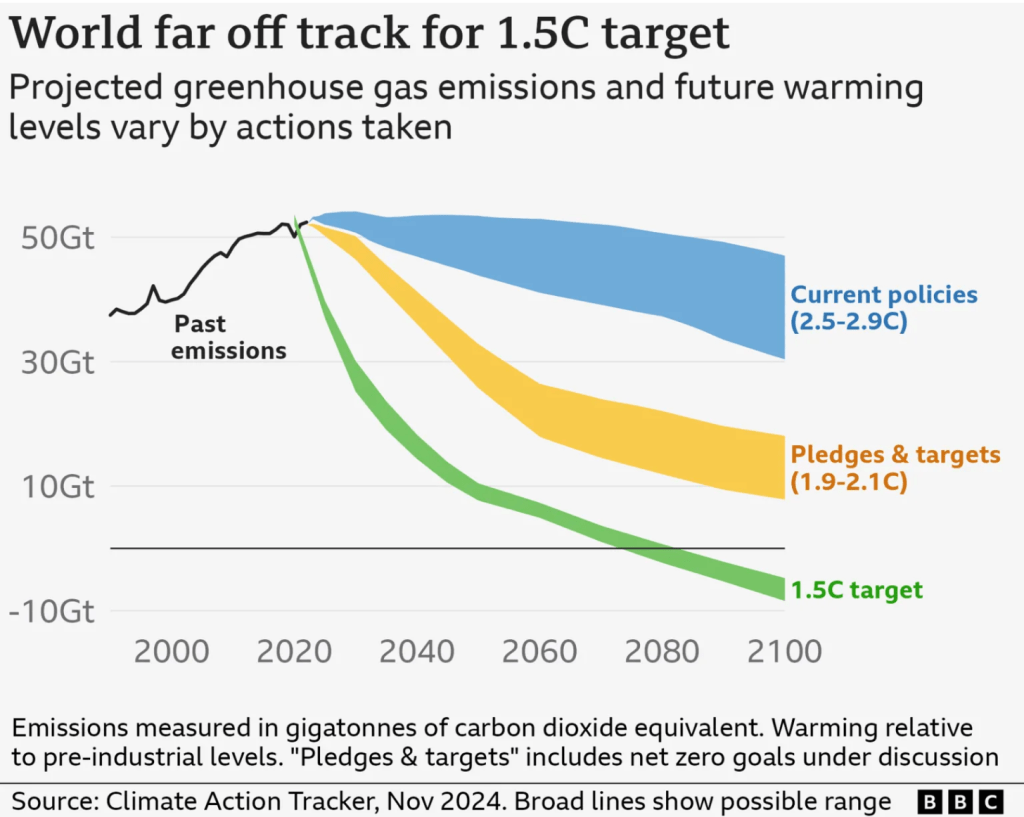
GHG levels are still rising. New fossil fuel projects are still being approved. At the same time, renewable energies are being deployed more and more at scale. Several countries have reached net zero emissions, and many are almost there.
“Eight developing countries have already achieved net-zero emissions: Bhutan, Comoros, Gabon, Guyana, Madagascar, Niue, Panama, and Suriname” – Foreign Affairs
Progress is not inevitable
It’s crucial to remember that progress is not inevitable. The upended energy markets as a result of the war in Ukraine was proof that plans can change and derail lots of progress. Who we elect, especially to the most powerful countries in the world that have the most leverage to do the most good or the most bad on climate, is crucial. Demand for fossil fuels continues to rise thanks to incessant economic growth and hugely energy-demanding technologies like AI.
It’s not over
According to the UN, emissions already released by human activity to date are unlikely to cause more than 0.5°C additional warming this century. So likely no more than 0.5°C of warming is already baked in. That’s still a lot of warming, but it also means it’s not too late for our current and future actions to have a huge impact. Every tenth of a degree averted means so many lives saved.
The current US administration may be doing everything in its power to derail climate progress, but they are going against the stream of nearly the rest of the world. Regardless of its historical global influence, the US only represents around one eighth of global carbon emissions, and other countries aren’t going to follow us back into the dark ages.
Even in the US, progress is not necessarily stalled. 1) Despite federal divestments from solar and wind, their foothold in the grid and the market is already too strong to stop. 2) This administration is favorable to geothermal power, which is an incredible renewable resource and opportunity to utilize and repurpose existing oil and gas infrastructure for clean power. And 3) thankfully, states and cities all across the US have the power to continue pushing forward climate progress in the wake of federal hostility.
Clarity in Catastrophe is an independent, reader-supported publication. You can support independent writing and art by subscribing to my Substack and engaging with my posts. Thank you!

 Clarity in Catastrophe
Leave a comment