Part 1 of how to resist Trump’s threats of democratic destruction
What’s happening in the US right now? We’re 2 months into Trump’s second presidency, and so much *crazy shit* has happened, it’s actually not possible to fully keep up.
Let’s move beyond the vague, safe assessment of ‘Times are weird right now’ that I’ve heard a lot. But times are super weird, so how to describe this moment?
I’ve noticed a lot of people labeling Trump’s actions as fascism at this moment, and I understand why. To defeat fascism (before it finishes unfolding), we have to first understand what it is, determine if it is, and if applicable, acknowledge that it is.
The Anti-Authoritarian Playbook has an excellent explainer piece about what exactly fascism is, and if it’s a fitting label for this moment. As Nakagawa explains, fascism has these core elements: ultranationalism, centralized authority, anti-democractic tendencies, militarism and violence, mass mobilization and propaganda, suppression of opposition, and corporatism. The Trump administration’s actions fit the bill for an alarming amount of these components:
- Nazi sympathizing and Musk’s Nazi salute (Ultranationalism)
- Trying to scare away all federal agency authority in order to centralize and expand his power (Centralized Authority)
- Trump is a convicted felon with no respect for the rule of law (Anti-democratic tendencies)
- Trump encouraged a violent coup (Jan 6) and pardoned those who took part, ignited by his false accusations and attempts to overturn fair election results (Militarism and violence, Mass Mobilization & Propaganda)
- Trump’s attempts to ‘flood the zone’ with a massive flurry of executive orders so we are overwhelmed into submission and obtain a false impression of how much power he has (Anti-democratic tendencies)
- DEI crackdowns (Anti-democratic tendencies)
- He has literally repurposed elements from Mussolini (y’know, the founder of fascism), including the promise to make the nation ‘great again,’ and implementing a campaign to ‘Drain the swamp’ of civil servants as one of his core priorities.
- Right before election day, Trump spoke of America as an occupied country and that he was going to liberate it (‘the enemy within’)
There are of course many more examples, but you get the point.
The ways in which Trump’s rule is not (yet) full-fledged fascism include a lack of unified ideology, the remaining presence of democratic institutions (like courts and state governments) and counter-movements advocating for civil rights and democracy, and no state-led corporatist structure (Is It Fascism Yet?). Nakagawa notes that there are various players who share the goal of dismantling democracy, but with differing motivations. It’s important to note those ideological divisions, as they are holes that resistance can exploit.
In his post “What’s so bad about fascism?,” journalist Jay Michaelson discusses the failures of the label of fascism. He argues that calling Trump fascist can backfire because to those who watch right-leaning news outlets, it sounds hyperbolic and hysterical, and because the label has been used on almost every Republican president since Nixon. The real problem is the abstract nature that the word “fascism” has taken on. Michaelson proposes making it clear to people the specific things that are bad about fascism, the real people that are hurt by Trump’s fascist actions, right now (Both/And with Jay Michaelson).
I agree, but I don’t think that necessitates not calling fascist behavior what it is.
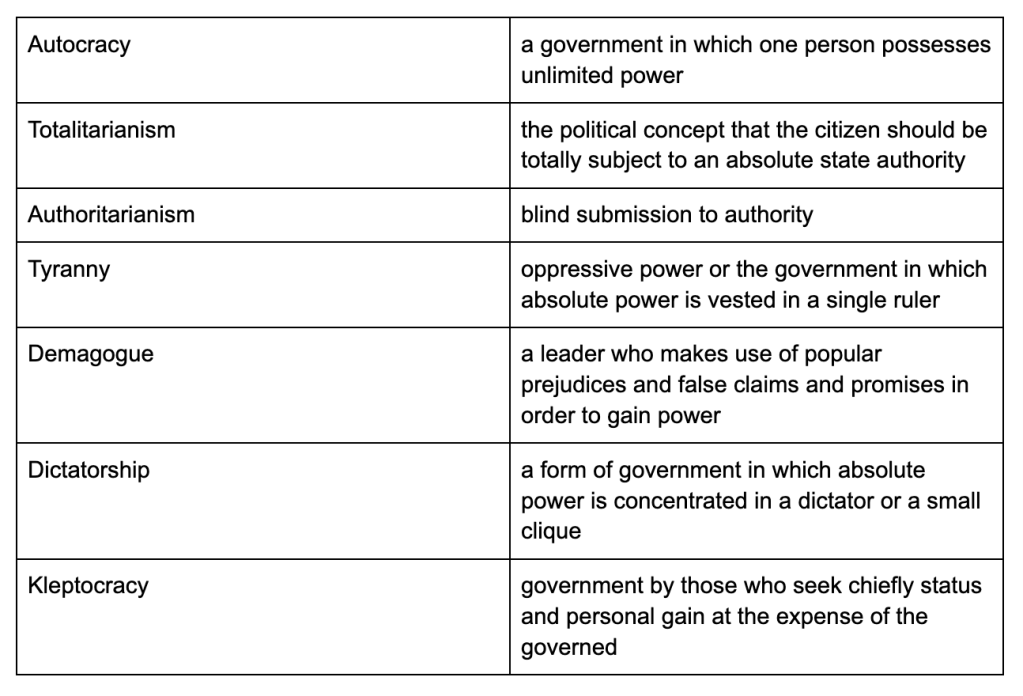
In case you were curious like me to know the differences between these very similar terms:
Probably what Trump’s vision board looks like
The importance of naming & understanding the moment we’re in
Put simply, it hugely informs our response. There are different strategies for resisting different types of threats. You can’t appropriately respond to a threat until you know what caused it. You can’t properly medicate or heal a disease without first diagnosing it and learning its cause.
Most Americans don’t want what’s happening.
It’s also very important to understand that Trump’s America is not a democratic reflection of what the majority of Americans want. It’s not true that half the country approves of what Trump is doing. Yes, Trump did win the election. He got a plurality, meaning 1.5% more votes than Harris, or 49.8%. As laid out in this video breakdown, only 25% of the 302 million US citizens voted for Trump (or 77 million). 1 in 4 is not a majority. Knowing this fact also informs the strategies of resistance. For example, it makes more sense to focus on organizing the 75% that don’t want Trump in office than on changing the minds of the 25%.
What specific threat does Trump pose? Is it fascism?
Obviously Trump is extremely dangerous. But we should put forth the effort to articulate the specific dangers he poses, the harm he is causing now and the kind of harmful world he is leading us into. Trump is a greedy and power-hungry agent of chaos with no moral backbone. I think he’ll go as far as the American people allow him to. He has openly praised fascists multiple times, so there’s no reason to think full-blown fascism isn’t his goal.
Trump has many fascist tendencies, but to call him a fascist implicitly assumes that he’s succeeding in those efforts. I think it’s better to call him a threat, because he hasn’t achieved a fascist regime. Trump is a wannabe fascist. He is actually just our president. He can only become something more if we allow him to. But he’s definitely trying.
This quote sums up the threat Trump poses: “The real threat is if he convinces the rest of us to believe he has power he does not have” (Ezra Klein’s op-ed “Don’t Believe Him”).
My verdict: Trump is a demagogue and wannabe fascist who’s trying to destroy American democracy.
It feels ridiculously obvious and unnecessary to explain why the destruction of democracy is bad. In the spirit of Jay Michaelson, I’ll explain that this is a bad thing because it means loss of individual freedoms and human rights (for just about everyone, eventually, not just the groups that are targeted in the very beginning – in this case, immigrants), and violence. It means giving up the notion that all humans are created equal, deserve equal opportunity and treatment, and all the structures that protect those ideals. It means complete lawlessness, and all decisions made by force, being totally at the will of one delusional, out-of-touch person. That puts all the facets of a liberal society that we love on the chopping board – the ability to travel as we please, recreate and love as we please, rely on medicine and healthcare, advance science, etc.
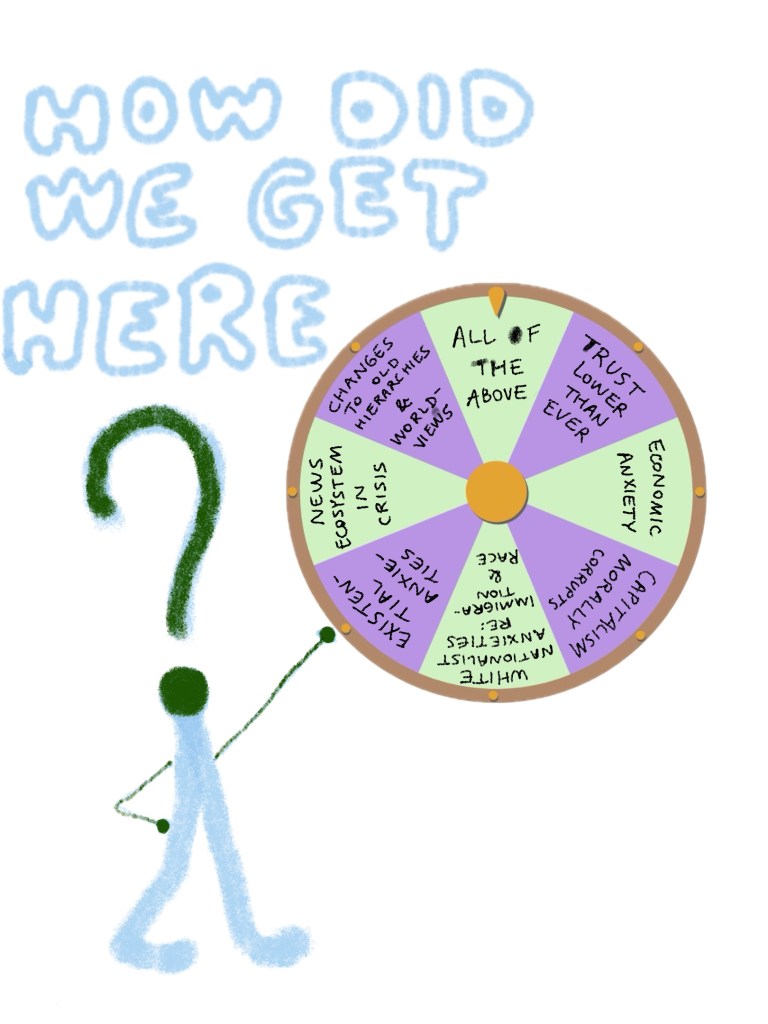
How did we get to this point?
The point where enough Americans are welcoming Trump’s brand of chaos and democratic destruction to get Trump in the White House for a second time. Fascism is knocking at our door because a plurality of voters decided the status quo was not working.
To understand this moment in American history, we have to zoom out and acknowledge the global trends. Democratic backsliding is occurring across the globe. In a report released last month, researchers found 38 cases categorized as experiencing minimal, moderate, or severe democratic decline (Cornell Chronicle).
Why?
While I don’t know the answer, I have my theories. Some possible contributors:
Trust is lower than ever. In the US, trust has been trending down since the 1990s. As high school seniors, Gen X’ers were “less likely to believe that most people were fair and helpful. And unlike many negative trends in the early 1990s, this one did not go away after the economy improved – Millennials and Gen Z’ers were also less trusting as high school seniors. Young Gen X’ers began a trend toward cynicism and mistrust that refused to fade.” (Generations by Jean M. Twenge). Today, we are extremely polarized and divided. People have lost trust in our institutions (partial thanks to a global pandemic) and many crave radical change, even if it comes in draconian form. Anti-establishment sentiment born from this distrust has culminated in Trump’s staying power. Social media algorithms surely play a role in this fracturing of the news ecosystem and mass spreading of conspiracy theories and declines in media and news literacy. Social media algorithms love and amplify divisive culture wars. Republicans have a robust echo chamber and media ecosystem that is happy to both collaborate with the algorithm’s perverse proclivities and enable Trump’s constant lies.
Economic insecurity is a classic factor that helps make fascism appealing (Foreign Policy in Focus). In polling during the presidential election, only 25% said their financial situation is better than four years ago. Wages have also not outpaced inflation in most parts of the country over the last four years (Pod Save America). Importantly, economic insecurity is not the same as genuinely struggling economically. One can be rich and yet somehow be anxious about not having enough. The key component is fear. In any case, these are indicators that economic insecurity in the US is a factor in growing fascist impulses among the electorate.
Unprecedented levels of anxiety, which existential crises like the climate crisis and multiple wars are contributing to. History tells us that when existential anxiety is high, people start craving a simple answer, even a savior. People want to feel a sense of control. Fascism has proven to successfully, and deceptively, market itself as a solution that offers increased control and autonomy (by taking rights away from others).
White nationalist anxieties about race and immigration in our more-globalized-than-ever world. Thanks to globalization and the spread of not just physical people but also ideas (thanks to the internet), the concept of nations is losing the salience of its meaning. To many nationalists, that’s inciting panic and fear. Countries like the US are also becoming increasingly composed of immigrants and people of color; white Americans are looking at a declining share of the racial/ethnic makeup of this country. Fascist wannabe Trump offers a way to cling to white power:
“In the mind of Trump, America is an exclusively white creation. This was in full display in Trump’s acceptance speech as presidential candidate at the 2020 Republican National Convention, where he said that what was unique to America was the spirit of the conquest of the land and the West by white ‘ranchers and miners, cowboys and sheriffs, farmers and settlers,’ a white world.” (Foreign Policy in Focus).
Other cultural changes to traditional hierarchies. Similar to anxieties in response to changing racial makeups, some feel anxiety in response to changes in the traditional gender narratives and hierarchies (Foreign Policy in Focus). In both cases, that’s attributed to a sense of loss of power and control.
Capitalism morally corrupts. Racism also lends itself to fascism. Fascism is also a moral failing. Reverend Dr. Martin Luther King Jr. frequently spoke about this. He always saw America as highly susceptible to authoritarian takeover, due to this country’s racist inclinations towards dictatorship over Black Americans. The capitalistic corruption of our government has also enabled many of our leaders to be bought, allowing room for fascism to slinker in.
How is democratic backsliding occurring?
“Increasingly, the researchers said, threats to democracy are emerging not from dramatic coups, military aggression or civil war, but from autocratic leaders leveraging democratic institutions – election officials, legislatures, courts and the media – to consolidate executive power. Such processes are incremental and harder to recognize in real time, they said, and may exacerbate polarization that further weakens trust in democracies.” (Cornell Chronicle). This sounds familiar.
Democracy is not a given, as evidenced by the trend of democratic decline in nearly 40 countries since 1990. No country is immune; democracy must be constantly fought for and protected.
Now that we have a sense of what’s happening and why, what can we do about it? The next few posts will be focused on how to resist democratic destruction. There are so many ways, let’s count them.

 Clarity in Catastrophe
Leave a comment